Devotion
Belief systems around the world invest birds with symbolic value as manifestations of divinity and emblems of nature and life. Visual artists have deployed birds as metaphorical conduits between the physical and metaphysical realms: between what is revealed by the material world and what they imagine it might mean. Birds can thus be holy messengers, omens, and celebrations of wonder. The ritual use of vessels in bird forms can demonstrate devotion, particularly when the vessel is dedicated to a particular god.
This section features works in which birds are no longer common animals, but carriers of elevated meanings. Here, crows become omens of death, falcons become protectors, and even a simple egg represents the connection between humanity and nature.
Gilles Le Castre, possible designer
Flemish, active 1525–1549
Poissonier Workshops, possible manufacturer
Flemish, active about 1490–1530
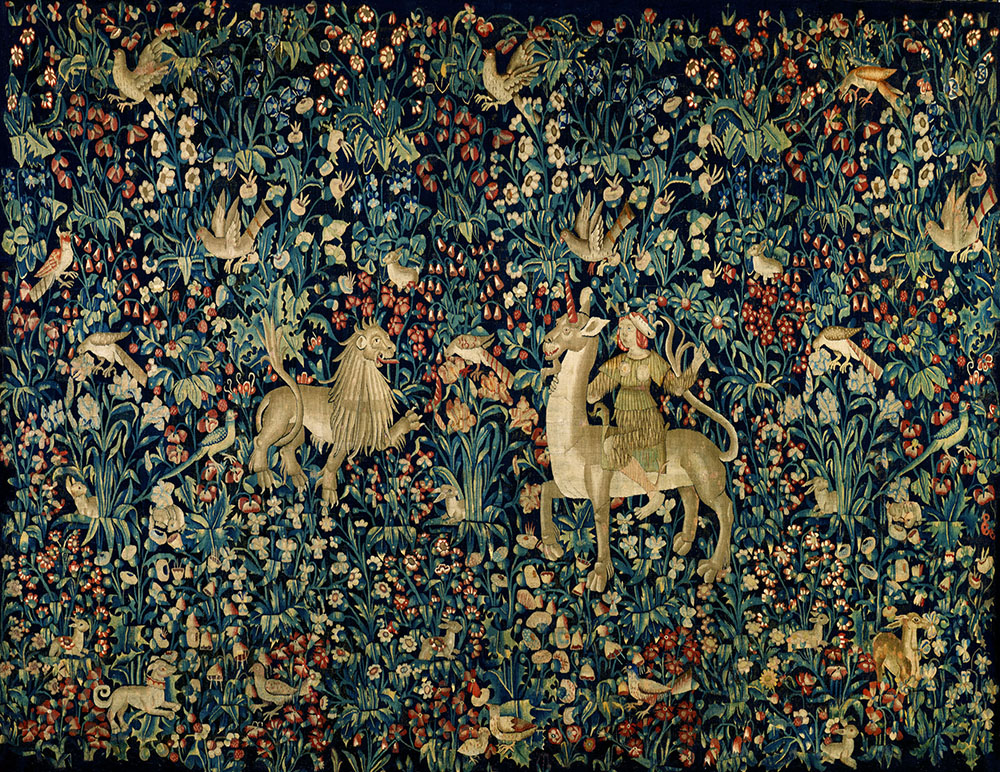
Tapestry with Wild Woman Riding a Unicorn
Wool and silk tapestry, about 1500–25
9 ft., 3 in. x 12 ft., 6 in. (282 x 381 cm)
Purchased with funds from the Libbey Endowment, Gift of Edward Drummond Libbey, 1947.7
Gilles Le Castre, possible designer
Flemish, active 1525–1549
Poissonier Workshops, possible manufacturer
Flemish, active about 1490–1530
Tapestry with Wild Woman Riding a Unicorn
Wool and silk tapestry, about 1500–25
9 ft., 3 in. x 12 ft., 6 in. (282 x 381 cm)
Purchased with funds from the Libbey Endowment, Gift of Edward Drummond Libbey, 1947.7


Allegory of the Unicorn and The Ducie Cup
Luxury goods have often incorporated decorative bird motifs. Revered for their ability to fly, birds were believed to have a deeper connection to the spiritual and natural worlds than humans. Millefleur (“a thousand flowers”) tapestries, like this one showing a wild woman riding a unicorn, featured patterns of fantastical creatures interlaced with intricate flora, in which birds could represent anything from fertility to romance to abundance.
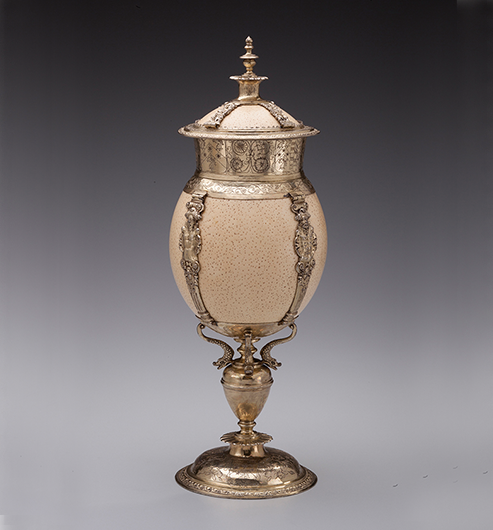
Birds were also valued as objects to be collected. European cabinets of curiosities, private galleries displaying strange artifacts from around the world, often featured exotic birds from colonized lands. Collectors sometimes emphasized the rarity and value of a specimen, such as the ostrich egg in the Ducie Cup, by having it mounted in a special setting of gilded silver.
Allegory of the Unicorn & The Ducie Cup
Nazca Potter
Peru, Nazca Valley
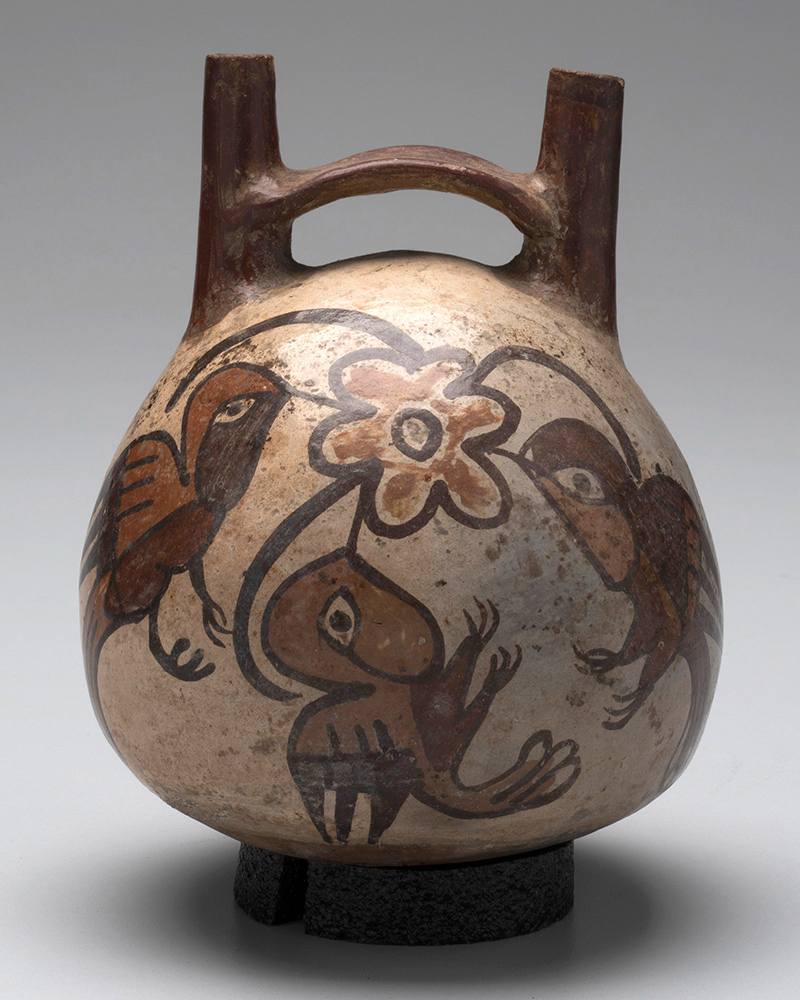
Double-Spouted Jar with Hummingbirds
Earthenware, 1st–4th century CE
Height: 5 3/4 in. (14.6 cm)
Gift of Mr. and Mrs. John D. Biggers, 1958.46
Double-Spouted Jar With Hummingbirds
The Nazca people of Peru’s southern coast practiced an animistic faith in which gods and animals were worshiped as protectors of vital forces. The hummingbird, for instance, was associated with life and growth in a variety of forms and was revered as a general benefactor of fertility and prosperity. This was likely due to its seasonal appearance, especially during the region’s rainy season, which also linked it temporally with Peru’s agricultural cycle.
The motif of three hummingbirds surrounding a flower is characteristic of pottery from early Nazca culture, which tends to include depictions of animals, plants, and supernatural scenes. The imagery on pottery from this period also features the thick, black lines, large eyes, and rich colors visible here.

Double-Spouted Jar With Humming Birds
Central Pomo
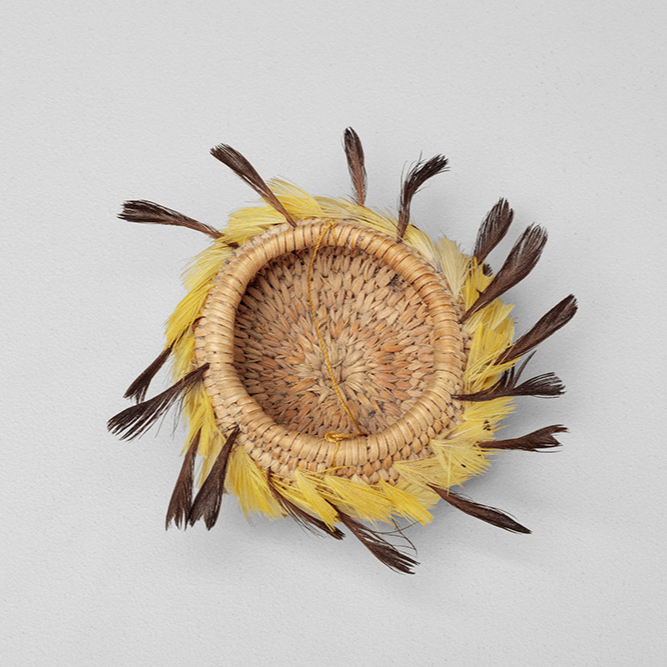
Miniature Yellow Feather Basket
Immature quail top-knots, feathers from breast of meadowlark and mallard duck, and willow,
1900–10
Diameter: 2 1/4 in. (5.7 cm)
Gift of Ralph T. Coe Center for the Arts, 2025.53
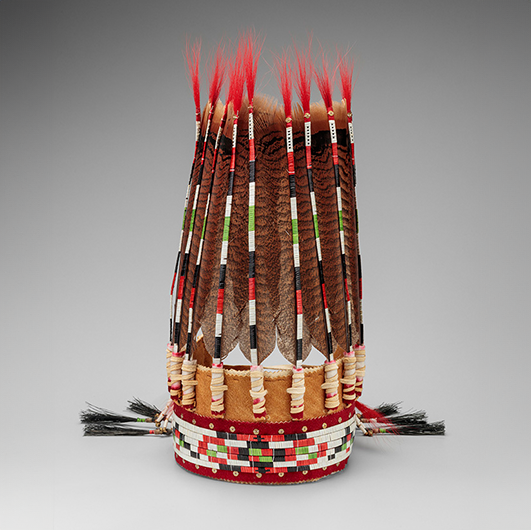
Leonard D. Harmon
Nanticoke and Lenape, born 1983, Philadelphia
He Walks Around (ayahpamskan)
Porcupine quills, horse and deer hide, deer hair, turkey feathers, glass beads, brass beads, brass Ethiopian bells, German wool, and commercial dyes, 2024
50 13/16 × 40 5/8 × 30 1/2 in. (129 × 103.2 × 77.4 cm)
Purchased with funds from the Libbey Endowment, Gift of Edward Drummond Libbey, 2025.2


Miniature Yellow
Feather Basket and He Walks Around (ayahpamskan)
Across Indigenous cultures of North America, birds symbolize power, honor, and the sacred. The headdress He Walks Around (ayahpamskan) is inspired by the practices of the Nanticoke and Lenape tribes, for whom turkey feathers represent the wearer’s honor, wisdom, and social status. Such headdresses were historically worn by respected tribal members, including war heroes and influential elders, whose demonstrations of honor and courage had earned them the right to serve particular roles within their communities.
Feathers harvested from native birds, like those woven into the miniature yellow feather basket, are among the most sacred materials in Indigenous making. Bird feathers are not merely decorative elements for Indigenous Americans but symbols of tradition and lived experience and expressions of respect and devotion through craft traditions.
Miniature Yellow
Feather Basket & He Walks Around
Christofolo di Marino
Italian
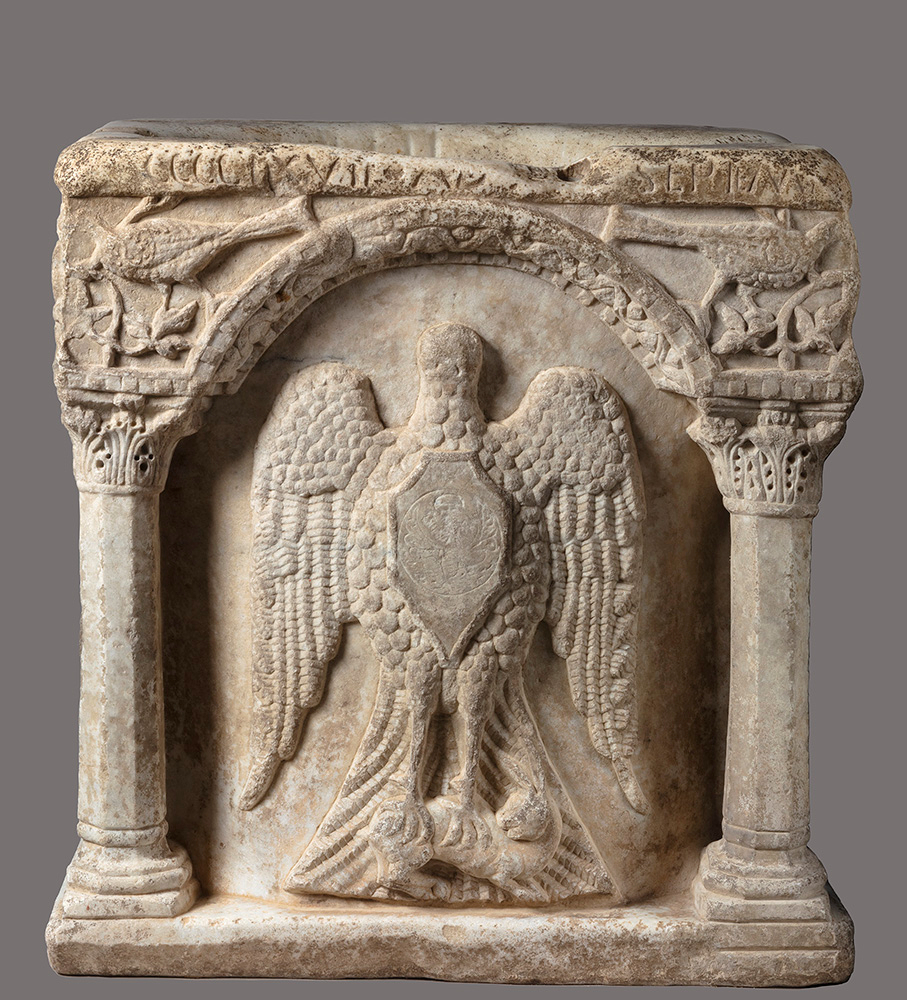
Wellhead with Animal Motifs
Marble, 1467
35 1/2 × 32 × 33 in. (90.2 × 81.3 × 83.8 cm)
Purchased with funds from the Libbey Endowment, Gift of Edward Drummond Libbey, 1936.19
Wellhead with Animal Motifs
The birds and birdlike figures depicted on this decorative Venetian wellhead are enjoying the physical benefits of the clean water it provides. For the people who drank from the well, however, the same waters may have had a deeper significance. The wellhead symbolizes the spiritual nourishment of Christian baptism and communion. The bird imagery contributes to that symbolism.
Especially important are the peacocks. Renaissance Europeans associated peacocks with immortality, which made them frequent symbols for the Christian soul. Whereas the other birds represented, such as eagles and griffins, manifest ideals of power and wisdom, the peacocks were meant to inspire people to think about water’s connection to resurrection and immortality as they drew from the well.
Wellhead with Animal Motifs


Death of a Pilgrim and Rooks in a Field
Felix-Joseph Barrias
French, 1822–1907
Death of a Pilgrim
Oil on canvas, 1887
25 5/8 × 40 1/8 in. (65.1 × 101.9 cm)
Purchased with funds from the Libbey Endowment, Gift of Edward Drummond Libbey, 1977.38
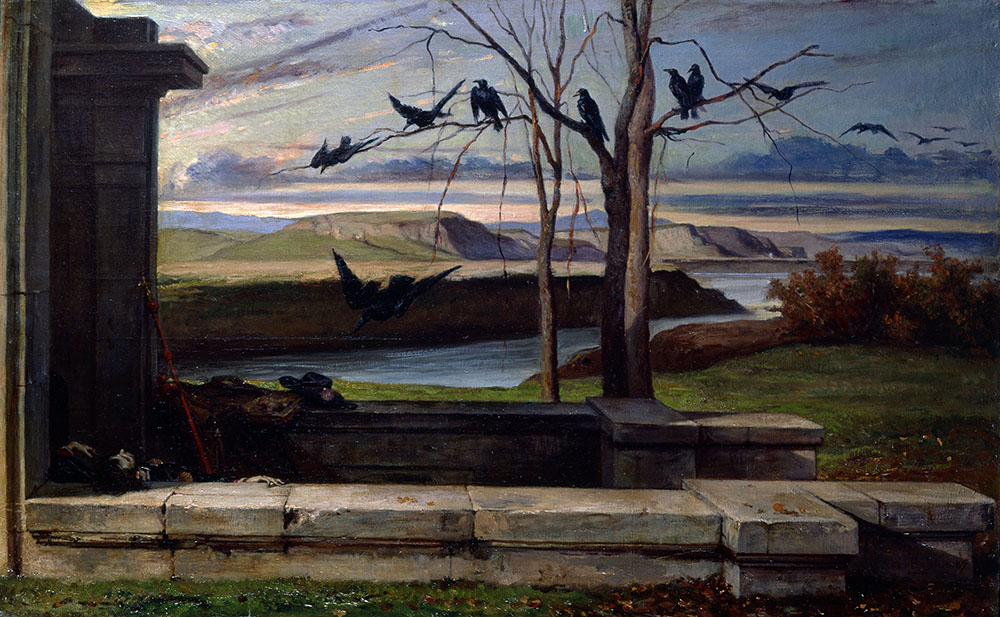
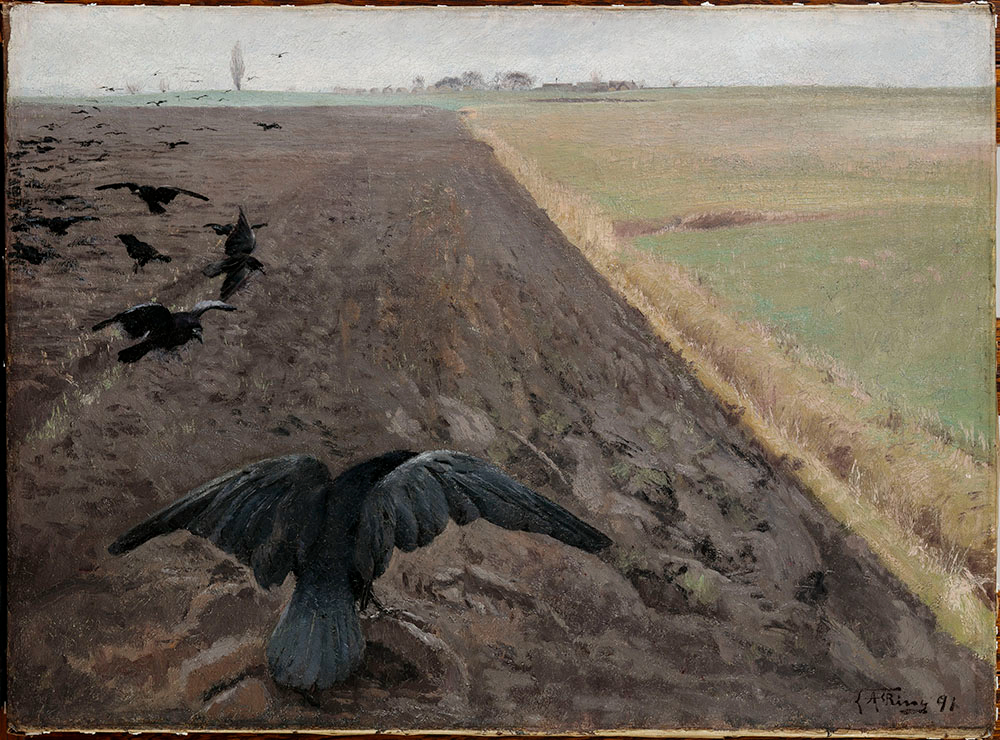
As scavengers that feast on carrion, members of the Corvidae family (particularly crows, ravens, and rooks) have, historically and across cultures, been regarded as ill omens: heralds of death and decay. Mythological depictions portray them as deities of war and deliverers of bad tidings, and their jet-black plumage is associated with the primal fear of darkness.
Their presence in Death of a Pilgrim conveys that the young man has already passed, as the crows swoop down to feast on his fallen body. Similarly, the birds in Rooks in a Field glean seeds, small animals, or any other remains uncovered by the field’s recent plowing. While their symbolic status endures today, modern research has also recontextualized corvids as highly social and intelligent creatures.
Laurits Andersen Ring
Danish, 1854–1933
Rooks in a Field
Oil on canvas, 1891
22 × 29.9 in. (56 × 76 cm)
Purchased with funds from the Florence Scott Libbey Bequest in Memory of her Father, Maurice A. Scott and with funds given in memory of Sarnoff A. Mednick, 2016.13
Death of a Pilgrim & Rooks in a Field
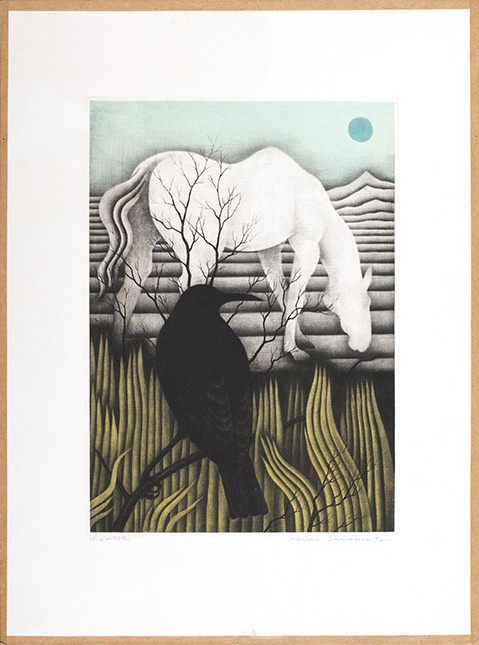
Koichi Sakamoto
Japanese, born 1932
White Horse with Crow
Etching with mezzotint, after 1950
15 × 11 in. (38.1 × 27.9 cm)
Gift of Norman L. Sandfield, 2015.30
White Horse with Crow
A dark crow looks over a field in which a white horse grazes. Crows (karasu in Japanese) have long been associated with Yatagarasu, the god of guidance in Shinto belief, because of his appearance as a three-legged crow. Visions of Yatagarasu are often understood to signify evidence of divine will in human affairs or to function as messages from the gods.
While this crow is not three-legged, its juxtaposition with the white horse in the background may suggest spiritual symbolism, as white horses are considered sacred messengers and steeds for the deities of Japan. These horses are still present in ceremonies and are generally thought to drive out evil and bring good luck if seen during the new year.

White Horse with Crow
Attributed to Kanzan
Japanese, 20th century
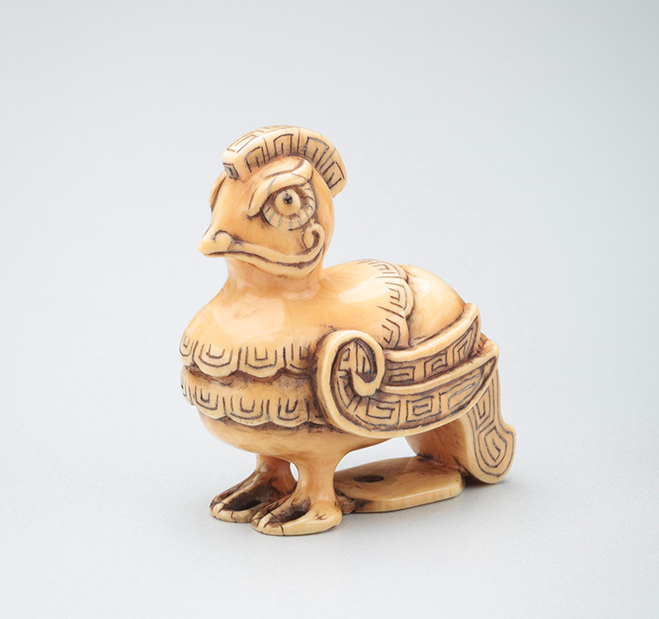
Netsuke: Ho Bird (Mythological Phoenix)
Ivory, 1965–74
15/8 × 7/8 × 1 1/2 in. (4.1 × 2.3 × 3.8 cm)
Gift of Richard R. Silverman, 2005.79
Japan
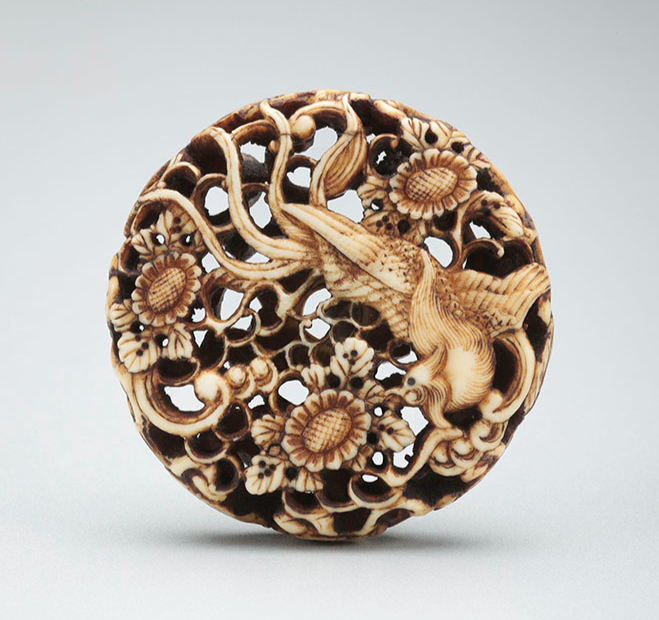
Netsuke: Phoenix and Flowers
Ivory, late 19th century
Gift of Richard R. Silverman, 2013.119
.jpg)

Netsuke: Ho bird
(mythological phoenix)
and Netsuke: Phoenix and flowers ryusa
The ho bird, also called a hō-ō or fenghuang, is among Japan’s most sacred mythological beings. Originating in ancient China, it is a harmonious spirit considered the ruler of all birds. Said to appear only in peaceful lands, the bird evokes tranquility, prosperity, and purity. It is also associated with fire and rebirth, linking it globally with the mythological phoenix and indicating the transculturally evocative power of birds.
Netsuke, decorative fobs used to fasten bags or other items onto traditional Japanese kimonos, were sometimes worn as talismans. The owners of these netsuke may have hoped to associate themselves with the virtues and characteristics of the beloved ho bird.
Netsuke: Ho bird
(mythological phoenix)
& Netsuke: Phoenix and
flowers ryusa
Cambodia, Angkor Wat
Khmer period (802–1431)
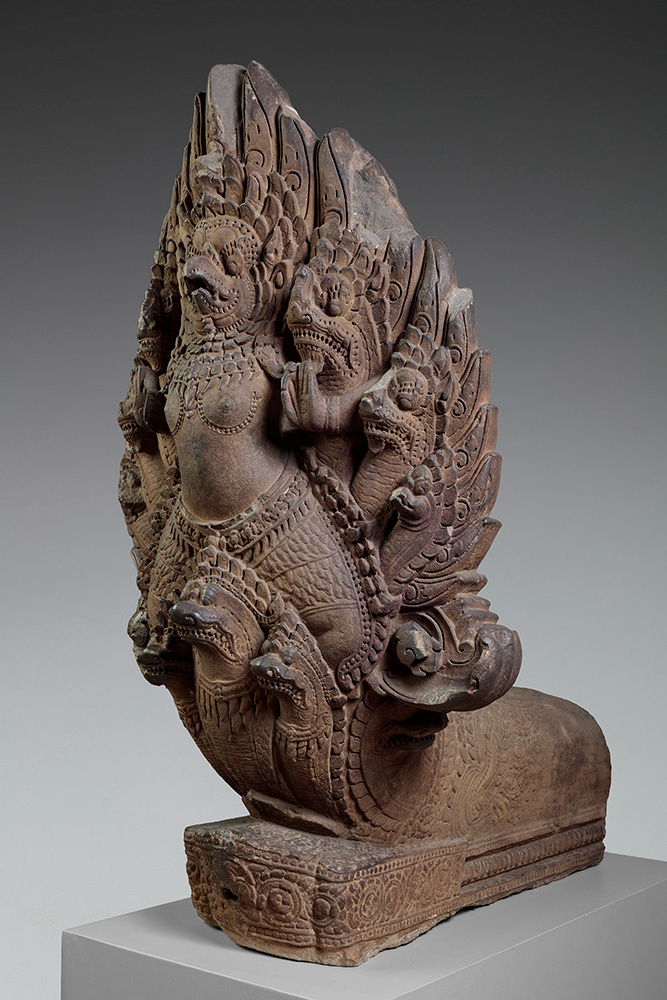
Garuda Balustrade Ornament
Sandstone, 1100–1200
51 1/2 × 30 1/2 × 43 1/2 in. (130.8 × 77.5 × 110.5 cm)
Purchased with funds from the Libbey Endowment, Gift of Edward Drummond Libbey, 1929.23
Garuda Balustrade Ornament
This temple sculpture depicts Garuda, a powerful, bird-headed figure from Hindu and Buddhist traditions who symbolizes transcendence through flight and his ability to move between earthly and godly realms. Standing atop a naga, a serpent deity associated with water and fertility, Garuda completes a sacred pairing meant to guard temple space. This balustrade ornament thus framed the temple as a sacred place of worship and a display of royal devotion.
Its monumental scale reflects the grandeur of Khmer temples, which were built by kings and viewed as gateways to the gods. This sculpture demonstrates how rulers used sacred avian imagery to display authority, wealth, and their connections to higher powers.

Balustrade Ornament
.jpg)
False Jar for Storing Organs
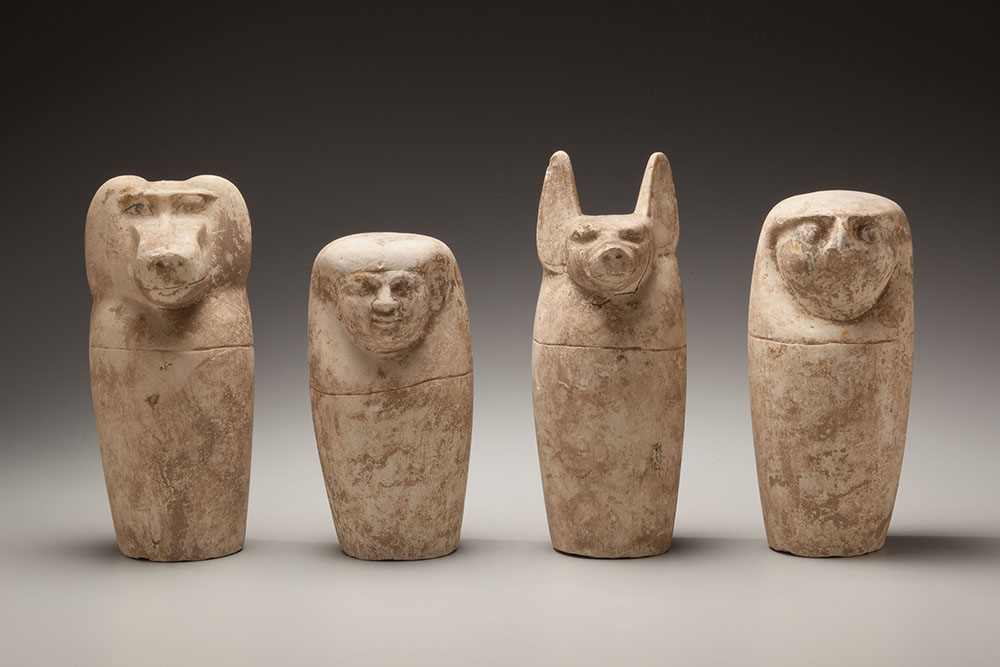
The four sons of the ancient Egyptian god Horus were funerary gods who protected human organs removed during the mummification process. Organs were placed into jars, each depicting one of the brothers, and later buried with the deceased. Falcon-headed Qebehsenuef (“kay-beh-seh-noof”) watched over and protected the intestines, while his brothers tended to the liver, lungs, and stomach. When this embalming practice was discontinued, the tradition persisted with fake jars such as this one.
Falcons—fierce and swift birds of prey—were not the only birds to be used as representations of the gods in Egypt, but their connections to Qebehsenuef; to Horus, god of the sky and kingship; and to Ra, the king of the gods, indicate that they were highly revered not only as manifestations of the divine but as symbols of protection, power, and royalty.
Egyptian Funerary Workshop
Active in present-day Egypt
False Jar for Storing Organs
Limestone, about 600 BCE
10 1/4 × 3 3/4 × 4 3/8 in. (26 × 9.5 × 11.1 cm)
Gift of Edward Drummond Libbey, 1906.17
Canopic Jar with Falcon-Headed Lid (Qebehsenuef)
Egyptian Funerary Workshop
Active in present-day Egypt
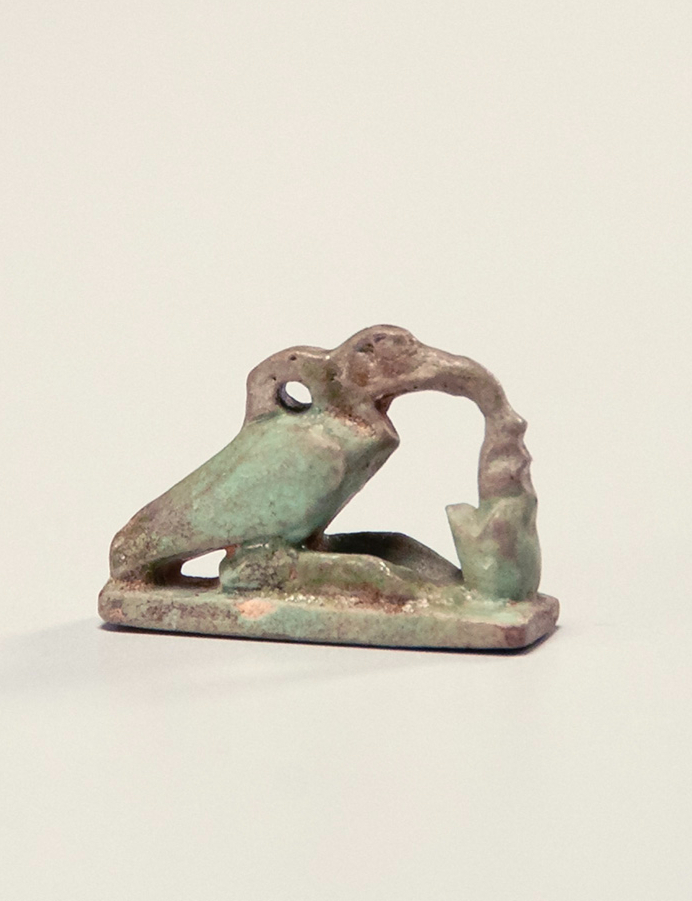
Amulet of Thoth as an Ibis with Goddess Ma’at
Faience, 747–332 BCE
13/16 × 1 1/8 in. (2.1 × 2.9 cm)
Gift of Edward Drummond Libbey, 1906.147
Amulet of Thoth as an Ibis with Goddess Ma'at
Birds often embodied divine qualities in ancient Egypt, derived from their ability to take flight and transcend humans’ physical limits. This amulet represents Thoth, the ancient Egyptian god of wisdom, writing, and the moon, who often took earthly form as an ibis.
Ancient Egyptians regularly wore amulets carved with representations of the gods as outward expressions of devotion. As evocations of divine protection in the afterlife, such amulets—especially those made of faience, a glass-like material associated with rebirth—could also be placed in tombs. Connected to the ibis’s beak is the feather of an ostrich, representing Ma’at, the goddess of balance and peace.

Amulet of Thoth as an Ibis with Goddess Ma'at
Earring with
Eagle Grasping Thunderbolts
Hellenistic Greek Workshop
Possibly southern Italy
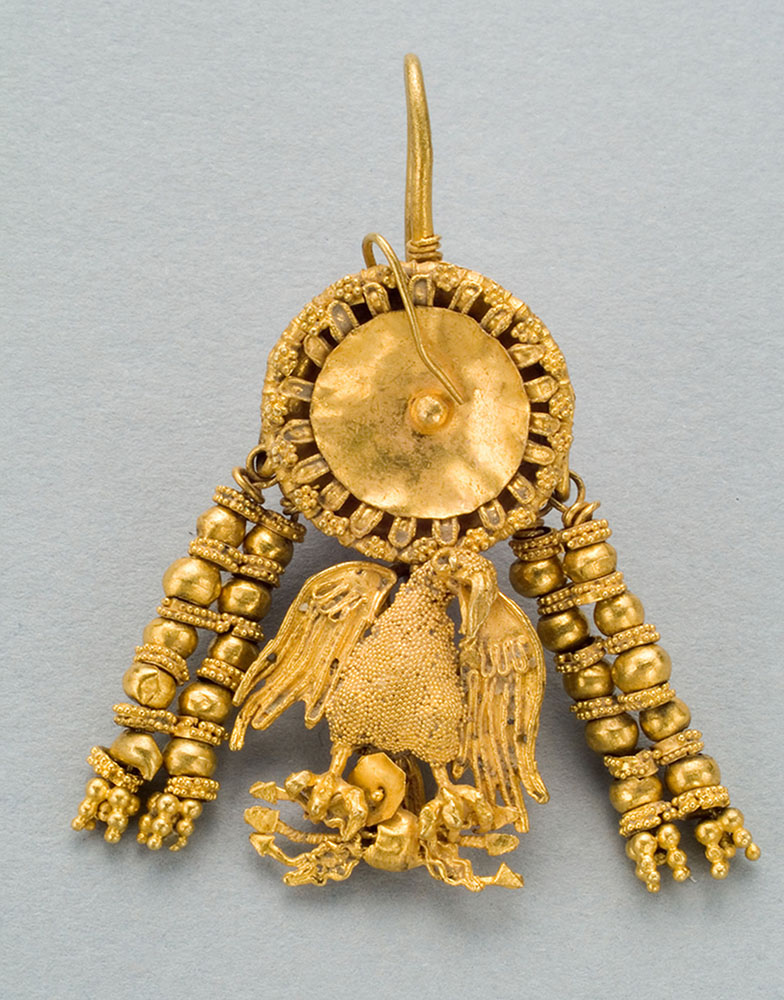
Earring with Eagle Grasping Thunderbolts
Gold, about 220–130 BCE
1 1/2 × 7/8 × 1/2 in. (3.8 × 2.2 × 1.3 cm)
Purchased with funds from the Libbey Endowment, Gift of Edward Drummond Libbey, 2007.10
This golden eagle and the thunderbolts clutched in its talons represent Zeus, the king of the ancient Greek pantheon of gods. Motifs of birds and other mythological flying creatures were popular design choices for pendants adorning earrings in ancient Greece. Dangling from the ears, they would appear to be suspended in the air. While ancient Greeks wore jewelry to adorn themselves and indicate wealth, accessories featuring imagery of the gods might also have been worn as protective symbols, both in daily life and in funerary garb.
During the Hellenistic period, jewelry was crafted with intricate designs, dazzling gems, and elaborate goldwork, indicating the profound dedication that Hellenistic artists of the time had to their craft.
Earring with
Eagle Grasping Thunderbolts
Placido Costanzi
Italian (Rome),1702–1759
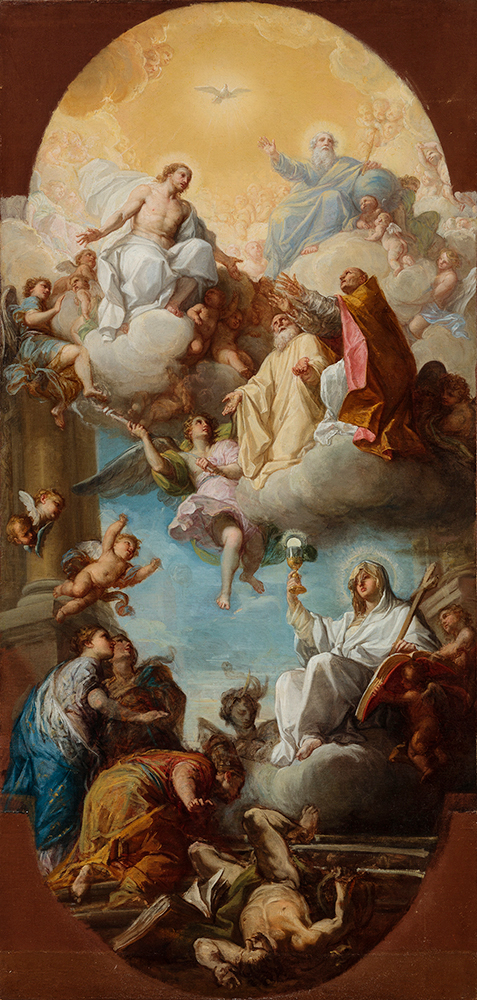
The Trinity with Saints Gregory and Romuald
Oil on canvas, 1726
62 × 30 in. (157.5 × 76.2 cm)
Purchased with funds from the Libbey Endowment, Gift of Edward Drummond Libbey, 1975.10
The Trinity with Saints Gregory and Romuald
While God the Father and Jesus preside over the other figures in this composition, a glowing dove, representing the Holy Spirit, hovers above them to complete the Christian Trinity. From its elevated position, the bird is both a spiritual presence and a symbol of heavenly power flowing downward, toward the saints and the earthly world below. In this sense, the dove exemplifies how bird imagery is used to bridge the natural and the divine realms and thereby communicates transcendence, devotion, and cosmic order. Here, the bird is not a part of nature but a sacred icon shaping the viewer’s encounter with the heavenly.